
Hashtags: #TagoreLegacy #EcoConscious #NatureBasedLearning #SustainableLiving #IndianHistory #EnvironmentalPioneer #Santiniketan
Introduction
Long before the West embraced environmentalism and nature-based education, Rabindranath Tagore—India’s Nobel laureate poet—was planting forests, writing eco-poetry, and designing open-air schools. His ideas, born in the early 1900s, are now UNESCO-recognized and more relevant than ever.
This blog explores:
✔ Tagore’s forgotten environmental activism
✔ How Santiniketan pioneered nature-based learning
✔ The science behind his vision
1. Tagore’s Environmental Awakening (Decades Before the West)
The 1916 Oil Spill That Shocked Him
- After witnessing an oil spill’s devastation in Burma (1916), Tagore wrote:“This poison in the sea… Progress shouldn’t mean killing our own cradle!”
- Decades before Rachel Carson’s Silent Spring (1962), he warned against exploitative industrialization.
Science Connection:
- Oil spills destroy marine ecosystems for decades (NOAA Study).
- Tagore’s critique mirrors modern “degrowth” movements.
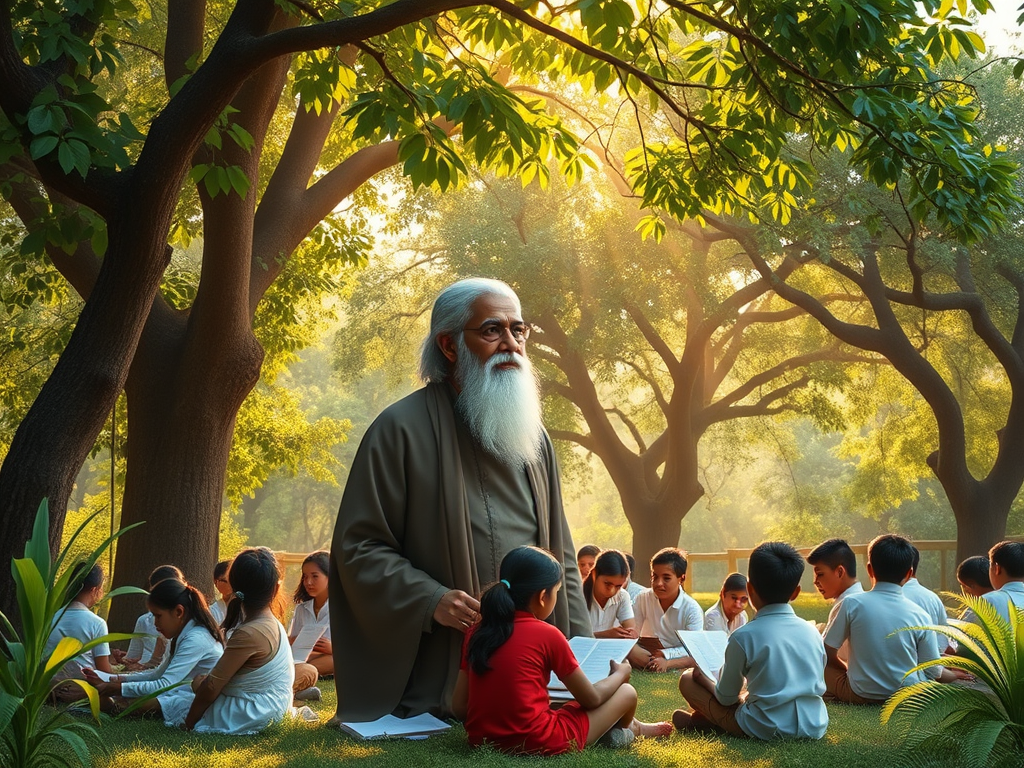
2. Santiniketan: The World’s First Nature-Based School (1920s)
Classrooms Without Walls
- Tagore’s Visva-Bharati University (founded 1921) rejected rote learning.
- Students studied under trees, with seasons as teachers:“The sky is our roof, the wind our textbook!”
Science Connection:
- Nature boosts learning: Kids in outdoor schools show 20% better focus (University of Illinois Research).
- Biophilic design (now a global trend) reduces stress by 15% (Harvard Study).
3. Briksharopan: The Festival of Trees (1928)
From Barren Land to Green Oasis
- Tagore started Briksharopan, a tree-planting festival, declaring:“Every tree you plant is a promise to the future.”
- Today, Santiniketan is a UNESCO World Heritage Site (2021).
Science Connection:
- Trees reduce urban heat by 5°C (NASA Research).
- Forest bathing (Shinrin-yoku) lowers cortisol by 16% (Japanese Studies).
4. Borsha Mongol: Celebrating Monsoon as a Teacher
Reconnecting with Nature’s Rhythms
- Tagore’s monsoon festival taught gratitude for rain:“The sky isn’t just giving water—it’s teaching us gratitude.”
Science Connection:
- Seasonal awareness aligns with circadian rhythm health (NIH Study).
- Water gratitude practices reduce anxiety (Positive Psychology Research).
5. Prakriti Parjaay: Poetry as Eco-Activism
Love Letters to Earth
- His Nature Genre poems (e.g., “If we sever our bond with nature, we lose our soul.”) predated:
- Biophilia hypothesis (E.O. Wilson, 1984).
- Ecopsychology (1990s).
Science Connection:
- Nature poetry reduces stress (University of Exeter Study).
- Environmental art boosts eco-consciousness (Journal of Environmental Psychology).
Why Tagore’s Legacy Matters Today
✅ Climate Crisis: His warnings about “progress at nature’s cost” resonate now.
✅ Education Reform: Schools worldwide are adopting forest schools (inspired by Santiniketan).
✅ Cultural Revival: His eco-festivals model sustainable traditions.
Tagore’s Call to Action:
“Fight for nature—creatively, joyfully.”
How to Honor Tagore’s Legacy
- Plant a tree (Join a local Briksharopan event).
- Read his nature poems (Gitanjali’s eco-verses).
- Advocate for green schools (Support outdoor learning).


Leave a comment