
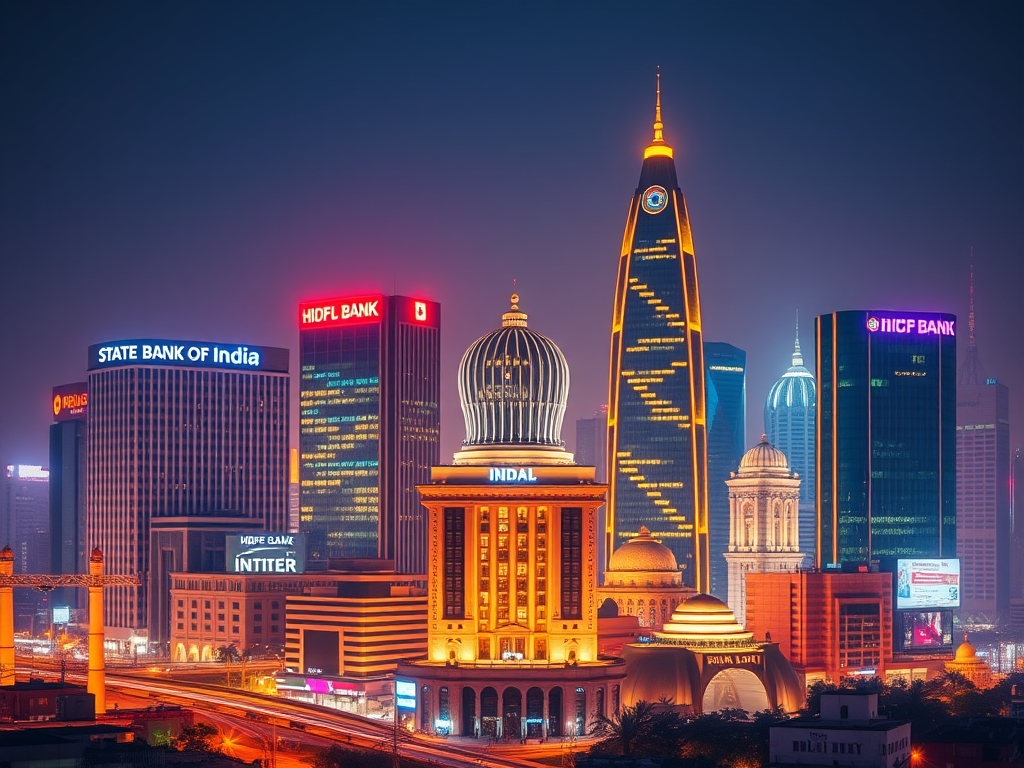
Ever wondered if some banks are so crucial that their failure could send shockwaves through the entire nation’s economy? The answer is yes. In India, these financial giants are known as Domestic Systemically Important Banks (D-SIBs), often dubbed “Too Big to Fail”. They are the bedrock of our financial stability.
This blog aims to demystify D-SIBs, explaining what they are, why they matter, who identifies them, and what it means for you, all based on the Reserve Bank of India’s (RBI) framework.
#IndianEconomy #BankingInIndia #DSIB #RBIGuidelines #FinancialStability #TooBigToFail #SBI #HDFCBank #ICICIBank #FinancialLiteracy #InvestSmart #EconomicGuardians
What if a Giant Bank Stumbles? The Ripple Effect
Imagine a scenario where a major bank collapses. The consequences would be dire:
- Millions of people could lose access to their hard-earned money.
- The availability of loans would plummet, effectively drying up credit.
- Businesses, starved of capital, could be forced to shut down.
- Widespread financial panic could ensue, destabilizing the entire economy.
It’s to prevent such a catastrophe that the RBI identifies a special category of banks.
Introducing D-SIBs: The Guardians of India’s Economy
D-SIB stands for Domestic Systemically Important Bank. In simple terms, these are banks whose failure would have a cascading negative impact, potentially crashing the entire economy.
These banks are characterized as being:
- Too big: Their sheer size in terms of assets and customer base is enormous.
- Too interconnected: They have extensive links with other financial institutions, forming a complex web.
- Too important to fail: Their collapse would lead to an unacceptable level of disruption.
Why D-SIBs are Crucial Pillars
D-SIBs are essentially the shock absorbers of the Indian economy. Their importance stems from several critical functions:
- They handle massive volumes of deposits from individuals and institutions.
- They are key financiers for big corporations, fueling industrial growth.
- They are deeply connected with Non-Banking Financial Companies (NBFCs), the Unified Payments Interface (UPI), and various other payment systems.
- They form a critical part of the nation’s banking infrastructure.
How Does a Bank Get the D-SIB Badge? The RBI’s Scrutiny
The Reserve Bank of India (RBI) is the authority that identifies these systematically important banks. The RBI assesses banks based on four key parameters:
- Size: This refers to the total assets held by the bank. Larger banks naturally have a bigger systemic footprint.
- Interconnectedness: This measures the bank’s links with other financial institutions. High interconnectedness means the failure of one can quickly spread to others.
- Substitutability: This gauges how easily the bank’s functions and services can be replaced by other banks or financial players. Low substitutability makes a bank more critical.
- Complexity: This looks at the range and intricacy of services and products offered by the bank. Higher complexity can make a bank harder to wind down or rescue in a crisis.
Meet India’s Current Financial Sentinels
As per the provided information, India’s current D-SIBs are:
- State Bank of India (SBI): Designated since 2015, placed in Bucket 3, and required to maintain an additional +0.80% Common Equity Tier 1 (CET1) capital.
- HDFC Bank: Designated since 2017, placed in Bucket 2, with an additional CET1 capital requirement of +0.40%.
- ICICI Bank: Designated since 2016, placed in Bucket 1, requiring an additional +0.20% CET1 capital.
(The image on page 1 also lists these three banks as controlling India’s financial stability.)
Decoding the “Buckets”: What Do They Mean?
The “buckets” assigned to D-SIBs are significant. Here’s what they imply:
- The higher the bucket, the greater the bank’s systemic importance and the perceived risk it poses to the financial system. Consequently, a higher bucket means a higher capital requirement for the bank.
- Bucket 3 (where SBI is placed) signifies the highest level of systemic importance among the D-SIBs.
- Bucket 1 (where ICICI Bank is placed) represents the lowest level of systemic importance within the D-SIB category.
This additional capital requirement acts as a crucial financial cushion for these banks, helping them absorb losses and maintain stability during severe economic shocks.
The Sheer Impact: What if a D-SIB Like SBI Collapsed?
To truly grasp their importance, let’s consider the hypothetical scenario of SBI collapsing, as highlighted in the document:
- Over ₹45 lakh crore in assets would be directly impacted.
- Crucial payment systems like UPI transactions could be halted.
- The distribution of government welfare schemes could be severely disrupted.
- Overall banking confidence across the nation would be shattered.
This is precisely why these banks are deemed “too big to fail”.
Why D-SIBs Should Matter to You
The status and health of D-SIBs have a direct bearing on every citizen:
- As an investor: While no investment is entirely risk-free, D-SIBs are generally considered safer institutions due to the stringent regulatory oversight and higher capital buffers.
- As a policymaker (or an informed citizen): These banks require constant policy attention and robust regulatory frameworks to ensure they don’t pose a threat to financial stability.
- As a citizen: The safety of your money, the smooth functioning of payment systems you use daily, and the overall health of the economy are directly linked to the stability of these banks.
In essence, D-SIBs form the financial backbone of Bharat (India).
Key Takeaways: Financial Stability’s First Line of Defense
- The RBI’s D-SIB framework acts as India’s financial seatbelt, designed to protect the economy from catastrophic bank failures.
- These three banks – SBI, HDFC Bank, and ICICI Bank – are not just ordinary lenders; they are guardians of India’s economic stability.
- Understanding their role and the regulations surrounding them can help you invest smarter and stay protected by appreciating the mechanisms in place for financial safety.
What are your thoughts on the role of D-SIBs in India’s economy? Share your views in the comments below!
Relevant Bibliography & Further Reading:
- Reserve Bank of India (RBI) Notifications on D-SIBs: The RBI periodically releases lists and frameworks related to D-SIBs. Searching the RBI website (rbi.org.in) for “Domestic Systemically Important Banks” will yield the most current official documents.
- Financial Stability Reports (FSR): Published by the RBI, these reports often discuss the assessment of D-SIBs and other systemic risks.
- Publications from the Bank for International Settlements (BIS): The BIS provides guidelines and research on systemic risk and the regulation of systemically important financial institutions, which form the basis for many national frameworks.
- Research articles on Indian Banking and Systemic Risk: Academic databases and financial journals often feature analyses of the Indian banking sector and D-SIBs.
Relevant YouTube Videos:
- “What are D SIBs or Systemically Important Banks? | RBI Policy | UPSC” by StudyIQ IAS:
- Search: “StudyIQ IAS D-SIBs”
- Why: Provides an educational breakdown often geared towards civil services aspirants, usually covering regulatory aspects.
- “Why RBI named SBI, ICICI Bank and HDFC Bank as D-SIB?” by Business Standard:
- Search: “Business Standard D-SIB explanation”
- Why: News channels often provide concise explanations of such financial terms and their implications.
- “Domestic Systemically Important Banks (D-SIBs) – Meaning & List of D-SIBs in India” by various financial literacy channels:
- Search: “D-SIBs India explained”
- Why: Many channels dedicated to financial education break down these concepts in simple language.
(Always ensure the information in YouTube videos, especially older ones, aligns with the latest RBI announcements for current D-SIB lists and capital requirements.)


Leave a comment